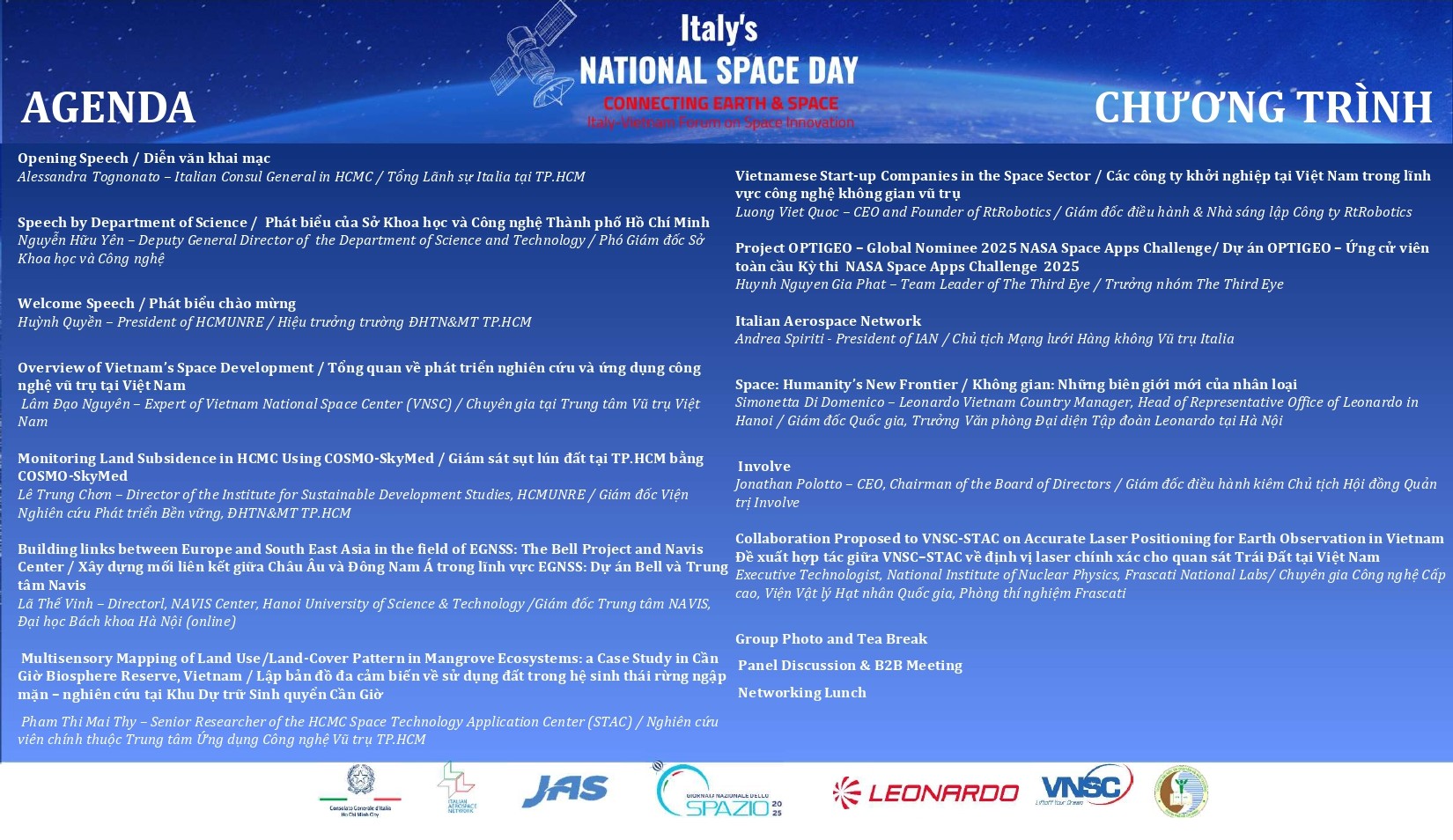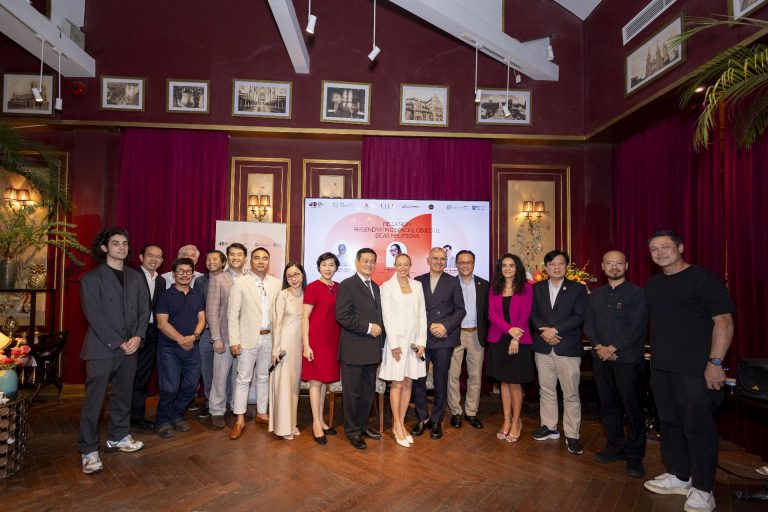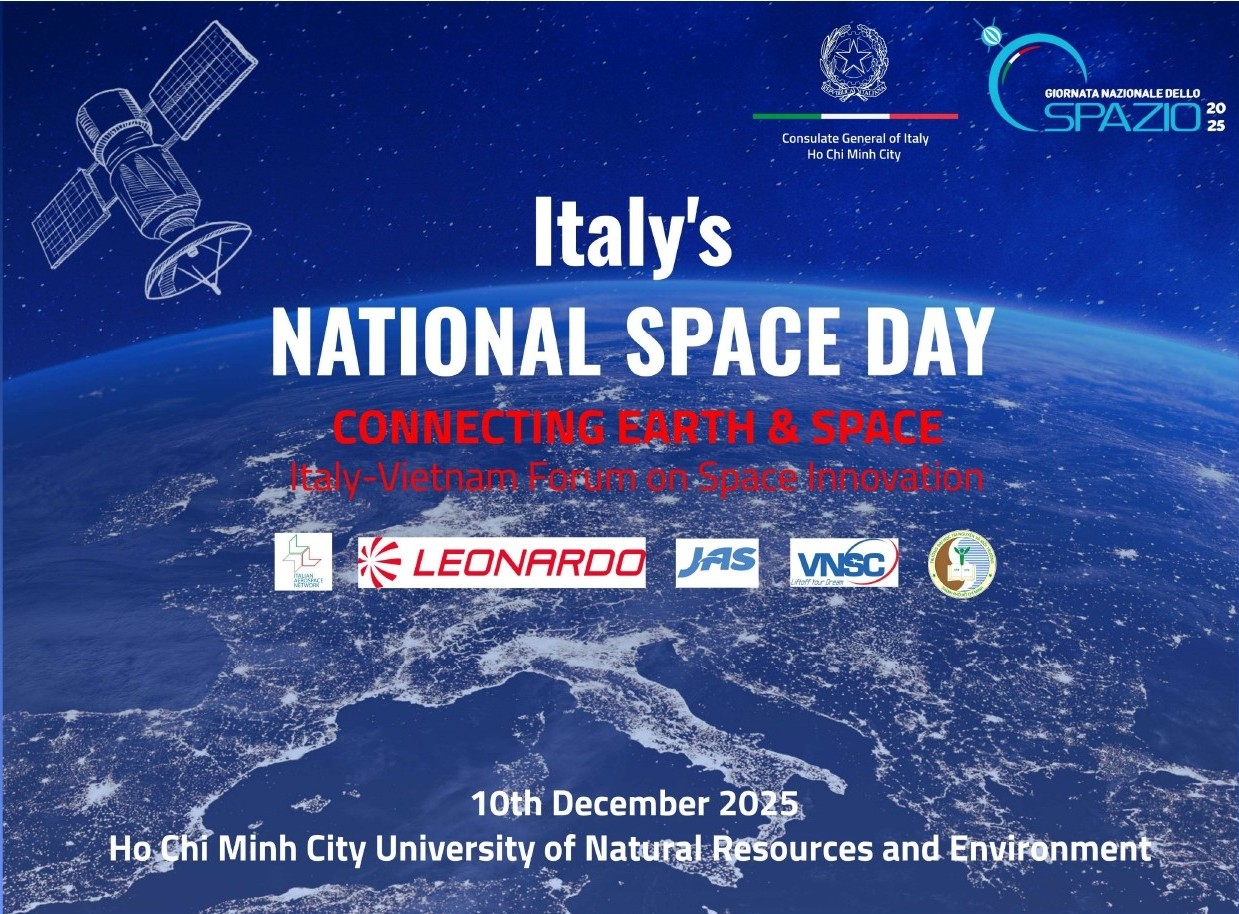
Il Forum, con il contributo di Leonardo, leader italiano nelle tecnologie spaziali e di sicurezza, di Italian Aerospace Network (IAN) e dell’Agenzia Spaziale Italiana (ASI), ha avuto l’obiettivo di rafforzare la cooperazione scientifica e industriale tra PMI italiane e vietnamite, accelerando lo sviluppo di progetti applicativi nell’osservazione della Terra e nelle telecomunicazioni satellitari, nonché di consolidare la collaborazione accademica attraverso scambi di esperti e programmi di formazione avanzata.
Il Vietnam – sulla base della Risoluzione n. 57-NQ/TW firmata dal Segretario Generale To Lam – ha inserito le applicazioni satellitari tra gli 11 gruppi di prodotti strategici nazionali. La regione meridionale, in particolare il Delta del Mekong e l’area di Ho Chi Minh City, è inoltre considerata dalle autorità una zona prioritaria per le attività di ricerca dedicate all’adattamento ai cambiamenti climatici.
In questo contesto, l’Italia – Paese tra i fondatori dell’ESA e dotato di un ecosistema industriale e accademico altamente avanzato – riconosce nel Vietnam un partner naturale per lo sviluppo di progetti congiunti in osservazione della Terra, resilienza climatica e sostenibilità, a sostegno della crescita socio-economica e delle strategie di adattamento climatico del Paese.
L’evento si è svolto in collaborazione con i seguenti partner locali: Vietnam National Space Center (VNSC – VAST), Ministry of Science and Technology (MST), Ministry of Natural Resources and Environment (MONRE), Department of Science and Technology of HCMC, Ho Chi Minh University of Natural Resources and Environment (da cui é stato ospitato), Università e centri di ricerca, Industrie e start-up tecnologiche vietnamite.
Kynote speech by Consul General Alessandra Tognonato:
It is a pleasure to welcome you all to the event « Connecting Space and Earth », as we celebrate the Italian National Space Day: a day in which we honour Italy’s legacy as a pioneering spacefaring nation, reaffirm our commitment to shaping the future of global space cooperation and explore opportunities for future collaboration with like-minded partners, as it is the case for our strategic partner, Vietnam.
Italy’s journey into space began more than sixty years ago with the San Marco programme: an extraordinary scientific, technological, and political achievement.
What made San Marco unique was not only its success, but its complete Italian conception: from design to engineering, from integration to launch operations, all carried out by an Italian team led by Luigi Broglio, working with NASA but maintaining full scientific leadership. Even the offshore launch platform, initially built in the Indian Ocean to maximise orbital efficiency, was an Italian creation.
In the years when the Soviet Union and the USA dominated the early space race, with Sputnik in 1957 and Explorer 1 in 1958, Italy dared to imagine that space could be within our reach as well. When San Marco 1 reached orbit in 1964, Italy became the third country in the world to launch a satellite with its own technologies, proving that vision and scientific leadership can overcome even the boldest frontiers. It was a resounding proof of our nation’s competence and an early sign of Italy’s long-term vision as a space power. And, of course, it was only the beginning.
From those foundations emerged a national ecosystem built on excellence in education, research, and engineering.
As early as the 1950s and 60s, institutions such as the Politecnico di Milano, the Politecnico di Torino, and the Aerospace Research Centre at Sapienza University were training the first generations of European specialists in propulsion, orbital dynamics, telemetry, and complex systems engineering.
This culture of innovation continues today, including through the pioneering Space Design programme of the Politecnico di Milano, which brings together engineering, architecture, and industrial design to shape the next generation of space habitats, interfaces, and human-centered systems.
Today, Italy’s aerospace sector is one of the pillars of our economy. It includes more than 650 companies, ranging from major industrial groups to highly specialized SMEs and an increasingly dynamic start-up landscape.
With revenues exceeding 18 billion euros, including 7 billion in exports, Italy is among the few countries capable of producing the full spectrum of space components, from launch technologies to satellite manufacturing, from robotics to habitation modules for the Moon and Mars.
Leonardo, in particular, plays a central role in Europe’s space capability: from advanced satellite platforms to cutting-edge sensors and cyber-secure space infrastructures, Leonardo is a driving force in strengthening both civil and security applications of space technologies.
Our astronauts embody this excellence: from Franco Malerba, Italy’s first man in orbit, to Luca Parmitano and Samantha Cristoforetti—both Commanders of the International Space Station—and Walter Villadei, recently engaged in new-generation missions. The next generation is also emerging, with young Italian engineers Anthea Comellini and Andrea Patassa joining the ESA Astronaut Reserve.
Italy’s global profile in the space domain continues to grow. Space is now a strategic pillar of our foreign policy and of the “growth diplomacy” promoted by the Italian Government to support exports, innovation, and industrial competitiveness. This is why Italy will chair the United Nations Committee on the Peaceful Uses of Outer Space in 2026–2027 and will co-chair the next ESA Ministerial Council. We are also strengthening partnerships with Europe, the United States, India, and soon Japan, as well as with Latin America and the United Arab Emirates.
We remain deeply committed to Africa, where the Luigi Broglio Space Centre in Malindi is evolving into a major hub for training, capacity-building, and technological development.
This international dimension reflects a clear objective: to create opportunities, jobs, and sustainable growth across our national territory through industrial investments, the expansion of facilities such as ESRIN, Avio, Leonardo, and the new Smart Space Factory of Thales Alenia Space, and through targeted support to start-ups and SMEs under Italy’s Export Pact.
Ladies and Gentlemen, Against this backdrop, Vietnam represents a natural partner for Italy’s future space cooperation, especially in the field of Earth Observation.
Satellite data can play a transformative role for Vietnam: from climate resilience to disaster prevention, from sustainable agriculture to urban planning and marine monitoring. Italy brings decades of expertise, advanced technology, and the ability to tailor solutions to local needs; Vietnam brings vision, dynamism, and a rapidly expanding scientific and industrial base. Together, we can develop joint projects that deliver tangible benefits for both our countries.
As we celebrate the Italian National Space Day, we do so with a spirit of innovation, partnership, and strategic foresight: the same spirit that guided Luigi Broglio and his team more than sixty years ago.
Italy will continue to advance in space: nationally, within Europe, and with global partners, combining industrial capability, scientific excellence, and forward-looking design with a strong commitment to the peaceful, sustainable, and responsible use of outer space.